Plaza story
Vintage Robots: Revisiting the Early Robots
The 20th century represented a major era of growth in robotics, ushering in a period of remarkable technological progress.
Logan Smith
City note
Sunny tip
The full plaza write-up continues below on the positive pulse board.
Board
NYC Good News
The 20th century represented a major era of growth in robotics, ushering in a period of remarkable technological progress.
The term “robot” was first introduced by Czech playwright Karel Čapek in his 1920 play “R.U.R.” (Rossum’s Universal Robots), laying the conceptual foundation for the development of robotic technology throughout the century.
In 1927, the silent film “Metropolis” featured the iconic robot Maria, a striking example of early imaginative explorations of humanoid machines.
During this period, British inventor Charles Lawson created “Superman Dennis,” a versatile robot, reflecting the inventive spirit and experimental approach to automation of the time.
Early Robots from the 20th century
It was not until the second half of the century that robotics achieved significant technical progress.
The 1950s saw the introduction of the first industrial robots, designed to perform repetitive tasks in controlled factory environments.
These pioneering machines laid the groundwork for automated manufacturing, marking a crucial step toward the robotics we know today.
As computers evolved, robot capabilities expanded. In the 1960s and 1970s, projects like Shakey the Robot at Stanford Research Institute explored artificial intelligence and autonomous mobility.
The period also saw the debut of Unimate, the first industrial robot deployed on production lines.
Yasutaro Mitsui’s Robot (1932)
Yasutaro Mitsui with his steel humanoid robot, Tokyo, Japan, 1932.
The Yasutaro Mitsui Steel Humanoid robot represents one of Japan’s earliest attempts at a human-like robot.
Its photograph is included in Haruki Inoue’s 1993 book, “Nihon Robotto Soseiki 1920-1938.”
The robot’s exposed electrical components and valves appear decorative, inspired by earlier designs like Wensley’s Televox.
This approach of showing inner mechanics became common in Japanese robots and toy designs.
A closer look at Mitsui’s robot shows limited mobility. It has no wheels, and its legs suggest walking was not possible.
The upper legs show marks hinting at bowing movements, aligning with Japanese cultural gestures.
The neck and fingers are fixed, and the arms move only at the shoulders and elbows. A power cord runs along its left leg.
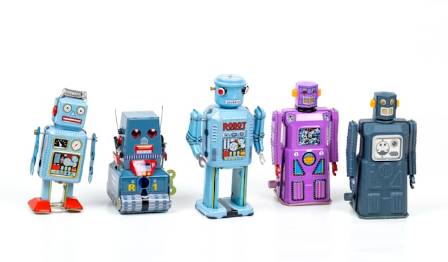
El Chispas Robot, Spain (1953)
Antonio Gual of Barcelona explains: in the 1950s, his father Antoni Gual Segura and colleagues at Radio Vilafranca collaborated to create “El Chispas” (“Sparks”).
This robot could move its arms, speak, and display sparks through a midsection window, captivating festivalgoers during the Fiesta Mayor.
Superman Dennis the Robot (1939)
Charles Lawson’s 7-foot-tall “Superman Dennis” could perform tasks like singing, controlling traffic, lighting a cigarette, and sitting or standing.
Though details are scarce, it reflected the imaginative approach of the era, showing robots as multifunctional human imitators.
Mobot (1961)
In 1961, Hughes Aircraft introduced Mobot, a mobile robot designed to assist with daily tasks like grooming and dressing.
The name combined “mobile” and “robot,” highlighting its autonomous mobility and multifunctionality.
The Mobot project aimed to create a robot capable of navigating and performing tasks independently.
It demonstrated potential uses in exploration, surveillance, and hazardous environments, incorporating sensors and computational systems for autonomous operation.
NASA’s 1965 Space Suit Test Robot Machine
Before astronauts walked on the moon, NASA experimented with a human-like robot to test spacesuits.
The hydraulic-powered android, developed between 1963 and 1965, could simulate 35 human motions and measure joint forces but leaked oil under stress.
It used sensors and hydraulic actuators powered by oil circulating through nylon tubing to mimic human movement.
The robot could swivel its hips, raise arms and legs, shrug, clench fists, and shake hands, but its extremities could not handle full operational pressure without leaking.
Sepulka of Soviet Union (1962)
Developed in 1962 by the All-Union Society “Znanie,” Sepulka was a radio-controlled guide robot with pre-recorded speech.
Named after a character from Stanislaw Lem’s stories, it could move within a 20-meter radius and demonstrate guided interactions.
Freddie Ford (1960s)
Constructed mostly from car parts, Freddie stood nine feet tall, weighed over 360 kg, and had limbs and features made from automotive components.
Used at Ford exhibitions from 1967, it could respond to questions with humorous and promotional answers.
Cosmos the Robot, France (1958)
Cosmos, exhibited on the Seine, drew attention for its human-like interaction despite being a machine, demonstrating public fascination with robotics.
Robo Sensor (1982)
This robot could shake hands, measure grip strength and temperature, and comment on readings, illustrating sensor-based human-robot interaction.
Goro Robot (1964)
Goro could walk, bow, wink, and communicate via radio, showing the emerging focus on robots designed for social engagement.
Gygan (1957)
This radio-controlled Italian robot featured car headlight-like eyes and stiff movements, debuting at a Milan trade fair in 1957.
Barbarossa Robot (1909)
Created by Adolph Whitman, this robot could walk, speak, sing, whistle, and laugh. Its intricate mechanical structure mimicked human behavior remarkably closely.
Unimate Robot (1961)
The first industrial robot, Unimate, was deployed at a General Motors plant to transport die-cast parts and perform welding, protecting workers from hazardous tasks.
Eric, British robot (1928)
Eric could turn its head and bow, reflecting early attempts at socially interactive humanoid robots in Britain.
Arok Robot (1970s)
Arok could vacuum, mix drinks, lift up to 150 pounds, walk the dog, and interact with people. Powered by automobile batteries, motors, and relays, it combined household functionality with mobility and control via TV remote.
Leonardo’s Robot (1492)
Constructed using pulleys and cables, this knight robot could sit, stand, raise its visor, move its arms, and operate a jaw, providing an early blueprint for human-like automation.
The robot Maria from Metropolis (1927)
This iconic film robot, designed to resemble a human woman, combined early special effects and technical ingenuity to manipulate workers and maintain control within the dystopian society of the film.
More from the plaza
BLOCK · en

Five Intriguing Insights into Punxsutawney Phil and Groundhog Day
On a recent Groundhog Day, the legendary Punxsutawney Phil observed his shadow, signaling that winter would linger for another six weeks. This quirky American custom, while arguably a peculiar mid-winter ritual, draws crowds at daybreak to a small Pennsylvania town to witness a rodent's climate prediction. While the tradition may seem somewhat taxing for both the early-rising spectators and the hibernating groundhog, it remains a beloved staple of American culture. Here are five fascinating details about the creature at the center of the festivities.
BLOCK · en

Painting flowers in watercolor
I have a deep passion for painting flowers in watercolor. Many people are amazed at how bright, dimensional, and lifelike floral watercolor paintings can appear, and I’m often asked how I achieve these results.
BLOCK · en
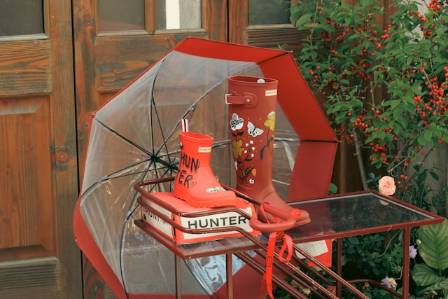
Wellies & Waterproofs: The British Art of Conquering the Rain in Style
In the United Kingdom, rain is far more than a meteorological footnote—it is the very backdrop of national life. It shapes the verdant landscape, dictates daily routines, and has forged a unique cultural identity rooted in pragmatism. To be British is to carry an umbrella and slip into a pair of Wellington boots at a moment's notice, transforming necessity into a statement of resilience.
BLOCK · en

4 Healing Power of Animal Companionship in Therapy
The profound bond between humans and animals goes beyond mere companionship; it holds the remarkable ability to promote healing and enhance mental well-being. Animals, with their innate qualities, offer comfort and support that can significantly impact our lives.
BLOCK · en

Top 8 Unforgettable Experiences in Madain Saleh (Al-Hijr)
Madain Saleh, also known as Al-Hijr, is one of Saudi Arabia’s most captivating destinations, rich in archaeological wonders and surrounded by dramatic desert landscapes. Once a thriving Nabatean city, it is now a UNESCO World Heritage Site that draws history enthusiasts, adventurers, and nature lovers alike. From ancient tombs to thrilling desert adventures, here are eight must-do activities that make a visit to this historic region truly memorable.
BLOCK · en

8 Stylish Ways to Wear a Bucket Hat
Bucket hats have made a big comeback and are now seen as both retro and modern accessories. Whether you want to add a subtle touch to your outfit or make a bold statement, these versatile hats can instantly elevate your style. Here are eight creative ways to wear them with confidence.