Mastering Nocturnal Scenes: An Analysis of Twelve Famous Night Paintings

Plaza story

Mastering Nocturnal Scenes: An Analysis of Twelve Famous Night Paintings

The subject of night presents a unique and evocative challenge for painters. It pushes artists to move beyond literal representation to capture mood, atmosphere, and the nuanced interplay of light within darkness. The following collection examines twelve significant artworks that successfully depict the nocturnal world, revealing the artistic techniques that bring these scenes to life.

D

Daniel Scott

City note

Sunny tip

The full plaza write-up continues below on the positive pulse board.

Board

NYC Good News

The subject of night presents a unique and evocative challenge for painters. It pushes artists to move beyond literal representation to capture mood, atmosphere, and the nuanced interplay of light within darkness. The following collection examines twelve significant artworks that successfully depict the nocturnal world, revealing the artistic techniques that bring these scenes to life.

Aert van der Neer – Moonlit Landscape With Bridge (c. 1640)

This 17th-century Dutch masterpiece is a profound study in tonal contrast. Van der Neer employed stark chiaroscuro, juxtaposing brilliant moonlight against deep, velvety shadows. The lunar glow gently defines the forms of the bridge, trees, and distant buildings, while its shimmering reflection in the water acts as a central focal point, masterfully framed by the bridge's arch. The scene, punctuated by small figures on a path, evokes a serene and contemplative stillness.

Aert van der Neer – Night Landscape With a River (c. 1700)

In another exemplary work, van der Neer introduced a richer, more varied palette within the nocturnal theme. He utilized cool blues and warm, tinted yellows to create a dynamic and dramatic sky. The composition is busier, featuring clusters of trees, reflective water, and a group of cows, yet the artist's careful control of light continues to direct the viewer's gaze seamlessly through the complex scene.

Vincent van Gogh – Starry Night Over the Rhône (1888)

Van Gogh’s interpretation of night transcends observation, channeling raw emotion onto the canvas. Replacing conventional blacks and grays, he constructed the scene from a vibrant tapestry of blues and yellows. The energetic, rhythmic brushstrokes in the sky and the stylized reflections of gaslights on the water convey a sense of wonder and celestial movement, illustrating his deeply personal and expressive vision.

Lesser Ury – In Front of the Cafe (Berlin at Night) (c. 1920)

Ury captures the modern experience of urban night, focusing on the psychological contrast between artificial light and natural darkness. The painting is a compelling play between the warm, inviting glow of a bustling café and the cool, mysterious expanse of the shadowy street. This powerful use of color temperature evokes distinct feelings of warmth and isolation within a single frame.

John Atkinson Grimshaw – Nightfall on the Thames (1880)

Grimshaw was a virtuoso of atmosphere, and this work exemplifies his ability to render tranquil, misty nocturnes. The painting possesses a quiet, almost meditative quality, achieved through subtle gradations of tone and exquisite attention to the effects of damp air on light. The still water and soft, glowing lights create a scene of perfect peace.

John Atkinson Grimshaw – Evening on the Pier

Here, Grimshaw orchestrates a sophisticated color theme. A cool, pale green light radiates from one corner, while the warmth of streetlamps illuminates the activity on the pier. The composition is anchored by the silhouettes of people, carriages, and boats, which serve as dark accents against the luminous background, demonstrating his skill in balancing color and value.

Jean-François Millet – Starry Night (c. 1850)
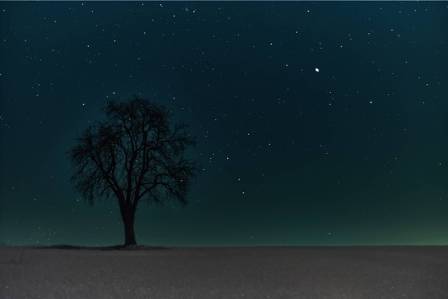
Millet’s approach is one of dramatic simplicity and reverence. He allows the foreground to sink into near-total darkness, forcing the viewer’s attention upward to a magnificent, expansive sky filled with stars, including streaking meteors. This stark contrast highlights the sublime scale of the cosmos against the humble, shadowed earth.

J.M.W. Turner – Fishermen at Sea (1796)

An early work showcasing Turner’s genius for drama, this painting employs forceful value contrast to depict the peril of a small boat on a tempestuous night sea. The brilliant slash of moonlight breaking through the clouds illuminates the churning waves, emphasizing nature’s overwhelming power and the fragility of human endeavor.

Ivan Aivazovsky – Stormy Sea at Night (1849)

Similar to Turner, Aivazovsky was a master of marine drama. In this work, a shaft of yellow moonlight cuts across the composition, defining the formidable peaks and troughs of the stormy sea. The artist expertly restrained the blues in the water, understanding that under a strong yellow light, they would appear darkened, thereby enhancing the realism of the illuminated scene.

George Inness – Watching the Sun Glow (1887)

A leading Tonalist, Inness specialized in mood and atmosphere. This painting demonstrates how light can be effectively conveyed using relatively dark colors. The hazy, muted glow on the horizon appears luminous precisely because of the deep, somber tones that surround it, proving that in painting, all effects are achieved through careful relational contrast.

George Henry – River Landscape by Moonlight (1887)
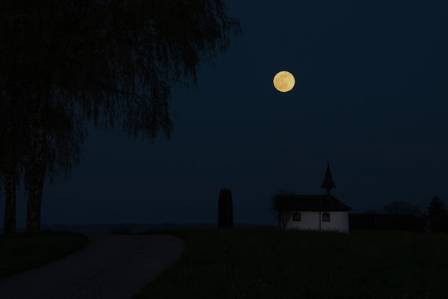
This painting is a bold and successful exercise in heightened color. Henry used rich, saturated purples and blues for the shadows and landscape, contrasting them with vivid yellows and oranges for the moonlight and its reflections. This departure from a more naturalistic palette creates a powerfully emotive and decorative interpretation of the night.

Childe Hassam – Rainy Midnight (1890)

Hassam captured a wet, atmospheric urban night not with deep darkness, but with a high-key, muted color scheme. Using fleeting, impressionistic brushwork and soft contrasts, he conveyed the diffusing effect of rain and mist. The distant streetlights become crucial points of reference, making their surrounding gloom appear deeper through comparison.

Core Techniques in Night Painting

Analysis of these works reveals three consistent artistic strategies:
  1. Pronounced Value Contrast: The effective illusion of light relies on the stark juxtaposition of bright highlights against very dark shadows.
  2. Strategic Ambiguity: Details are often suppressed or lost in the shadow areas, allowing the viewer's imagination to participate in completing the scene.
  3. Color Restraint: With notable exceptions like van Gogh and Henry, most artists use a muted, limited palette, as bright colors are rarely visible under low-light conditions.

Practical Guidance for Artists

Painting night scenes presents unique challenges, as working from direct observation is difficult. Artists are advised to synthesize information from multiple sources: memory, quick color studies, photographic reference, and the work of masters. The key is to identify and emphasize the core emotional idea of the scene—be it the silence of moonlight, the glitter of reflections, or the warmth of a window. Remember, creating the illusion of light is always an exercise in skillful contrast. In nocturnal paintings, it is generally more effective to exaggerate the contrast between light and dark than to understate it.

More from the plaza

BK

BLOCK · en

Inside the Luxury MPV

Inside the Luxury MPV

Family vehicles were once associated mainly with practicality, often prioritizing space and function over style or performance. For many years, minivans dominated this segment, offering roomy interiors and convenience but lacking in refinement and driving excitement.

BK

BLOCK · en

Fascinating Insights into the World of Antelopes

Fascinating Insights into the World of Antelopes

Antelopes are a diverse group of mammals with nearly 100 distinct species identified globally. While the vast majority inhabit the expansive African savannahs, these resilient creatures have adapted to a remarkable range of environments. They can be found in dense forests, thick brush, rugged rocky terrain, arid deserts, and even water-saturated marshlands. Social by nature, antelopes typically live in groups referred to as herds.

BK

BLOCK · en

13 Top Spots for Naked-Eye Stargazing in the U.S.

13 Top Spots for Naked-Eye Stargazing in the U.S.

Today, most Americans—and much of the global population—live under skies significantly dimmed by artificial light. This widespread glow obscures the natural night sky, to the extent that over two-thirds of people in the U.S. can no longer see the Milky Way from their homes.

BK

BLOCK · en

9 Most Beautiful Forests for Hiking

9 Most Beautiful Forests for Hiking

Few experiences compare to walking through a sun-dappled forest, surrounded by rustling leaves and birdsong. From ancient woodlands to mist-shrouded cloud forests, these nine destinations offer some of the world's most magical hiking experiences.

BK

BLOCK · en

10 Interesting Facts About Rabbits

10 Interesting Facts About Rabbits

The oldest known rabbit, named Flopsy, lived to be 18 years and 10 months old. Originally a wild rabbit, Flopsy entered the Guinness Book of Records under the care of its owner.

BK

BLOCK · en

Meet the Striking Spotted Sicklefish

Meet the Striking Spotted Sicklefish

Drepane punctata, commonly known by names such as butterfish, concertinafish, jetto, peppercorn, sickle-fish, silver moonfish, spotted batfish, spotted sicklefish, sicklefish, and spotted spadefish, is a ray-finned fish belonging to the family Drepaneidae, commonly known as the sicklefishes. Its natural distribution extends throughout the Indo-Pacific region.