Plaza story
Marine Life Spotlight: The Versatile Green Heron
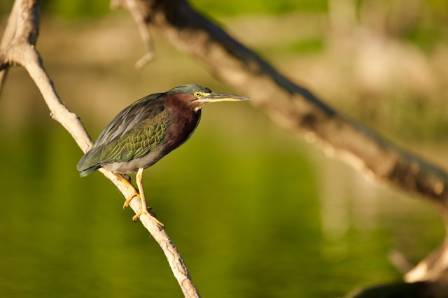
The green heron (Butorides virescens) is a compact yet sturdy wading bird frequently spotted throughout North and Central America. While its distinctive coloration can be subtle from a distance, a closer look in the right light reveals a stunning palette of deep red and gray plumage, topped with an iridescent green crown and back.
Camille Daphne Waverly
City note
Sunny tip
The full plaza write-up continues below on the positive pulse board.
Board
NYC Good News
The green heron (Butorides virescens) is a compact yet sturdy wading bird frequently spotted throughout North and Central America. While its distinctive coloration can be subtle from a distance, a closer look in the right light reveals a stunning palette of deep red and gray plumage, topped with an iridescent green crown and back.
Physical Characteristics and Appearance
The green heron possesses a short, thickset build that often leads to comparisons with the American crow. Its neck is adorned with reddish-brown feathers, while its upper body exhibits a greenish-gray hue that takes on a bluish shimmer in direct sunlight. This species features relatively short yellow legs and a slender beak colored in orange and black. Additionally, patches of yellow skin are visible around its eyes.
Juvenile birds look quite different, sporting primarily brown feathers with pale white streaking along their wings and necks. As they mature, they undergo a molting process to transition into their adult coloration. Full-grown adults reach lengths of approximately 18 inches and weigh up to 8.5 ounces. When in flight, their wingspan measures between 25 and 26 inches. Similar to other herons, they fly with their necks tucked back against their bodies in a distinctive S-shape.
Foraging Behavior and Habitat
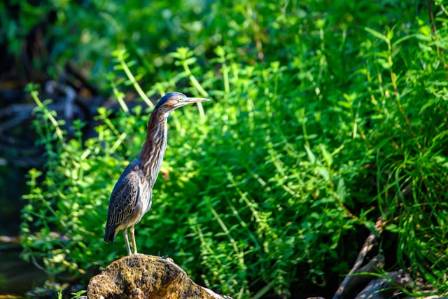
These birds are opportunistic hunters, primarily targeting small fish such as gizzard shad, sunfish, and minnows. Their diet is occasionally supplemented by amphibians, worms, insects, and crustaceans. Their hunting strategy is one of extreme patience; they stand motionless in the water or creep slowly along the shoreline. When prey is within range, they rapidly extend their retracted necks to strike with their sharp bills.
Remarkably, green herons are among the few bird species known to use tools; they sometimes drop insects or small objects onto the water's surface as bait to lure fish. While they are capable of diving or swimming to catch prey, they rarely do so to conserve energy and keep their feathers dry. In the wild, they must remain vigilant against predators: snakes and crows often target their eggs, raccoons prey on chicks, and large raptors may hunt the adults.
Green herons gravitate toward lush aquatic environments, including marshes, ponds, streams, estuaries, and mangrove forests. They rely heavily on dense vegetation for both concealment and nesting. They are found along the entirety of the continental U.S. coastline and migrate to southern regions like Panama during the winter. Within the National Marine Sanctuary System, they are common residents in sites such as Monterey Bay, the Florida Keys, and Mallows Bay-Potomac River.
Life Cycle and Social Interaction
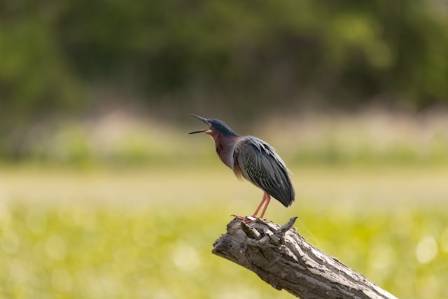
The breeding season for the green heron typically commences in April. To attract a mate, males engage in elaborate courtship displays, which include puffing out their neck feathers, swelling their throats, and snapping their bills. Their performance may also include hopping on one foot and emitting sharp vocalizations. Once a pair has formed, both the male and female collaborate on nest construction and take turns incubating a clutch of three to six eggs.
The eggs hatch after approximately three weeks. For the first month, the parents provide food through regurgitation until the chicks are capable of flight. Females are prolific breeders and can produce two broods in a single year. While they forage alone or in pairs, green herons are social birds that often live in larger colonies. They maintain communication through a series of sharp calls, often described as "kuck," "kyow," or "skiew." On average, these birds live for about eight years.
Conservation Status and Environmental Challenges
While green heron populations are currently considered stable, their secretive habits make them difficult for scientists to monitor accurately. Like many wetland species, they face several ongoing challenges. The primary threats to their long-term survival include habitat destruction caused by urbanization, water pollution, human-generated noise, and the broader effects of a changing climate. Protecting the vegetated shorelines they call home is essential for their continued success in the wild.
More from the plaza
BLOCK · en

Top 10 best looking vintage record players
We admit it: appearance matters to us almost as much as performance. Maybe even a little more. Call us superficial, accuse us of being distracted by design, or tell us we’re overlooking the real purpose of a record player. It won’t change our opinion that a great turntable should also be beautiful to look at. For us, a big part of the vinyl experience is enjoying the way the equipment looks and feels.
BLOCK · en
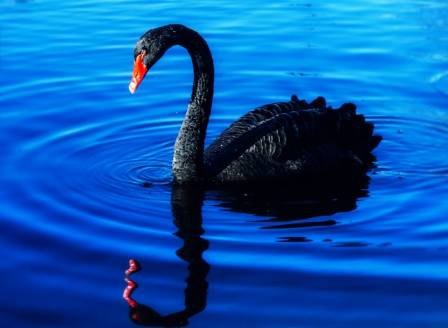
Discovering the Black Swan: Insights into Cygnus atratus
The Black swan (scientific name: Cygnus atratus) is a large, instantly recognizable waterbird that belongs to the swan family. It stands out as one of just three swan species native to the southern hemisphere. Back in the 1800s, this elegant bird was introduced to various countries as an ornamental addition to gardens and estates—but many managed to escape into the wild and establish stable, self-sustaining populations. Today, the Black swan remains a beloved attraction in zoos and private bird collections, and sightings of escaped individuals outside their natural range are not uncommon.
BLOCK · en

Great Salt Lake
Great Salt Lake is the largest saltwater lake in the Western Hemisphere and ranks among the world’s largest saline lakes. Its ecosystem represents a remarkable connection between humans, nature, water resources, wildlife, and survival. The lake’s diverse habitats, including wetlands, islands, and shorelines, support a wide variety of life such as plants, brine shrimp, reptiles, amphibians, mammals, shorebirds, and waterfowl.
BLOCK · en
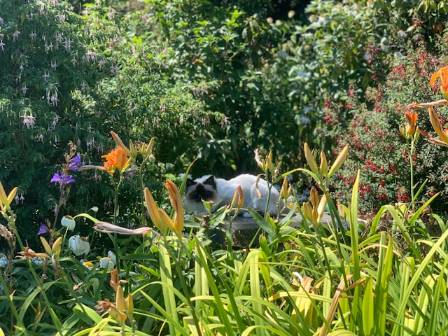
Keeping Your Outdoor Cat Safe
As a cat owner, few things are more stressful than letting your feline explore the outdoors and worrying whether they’ll return safely. While venturing outside can be exciting and stimulating for cats, it also exposes them to a range of hazards—from cars and predators to other animals and environmental dangers. If you want your outdoor cat to enjoy fresh air while staying safe within your property, you’re not alone. Many pet owners struggle with this balance, and the good news is there are several strategies to encourage your cat to remain in your yard.
BLOCK · en

The Giant Panda: Wisest of Beasts
Lately, I’ve been reflecting a lot on these remarkable animals, especially after re-watching one of my favorite films, Kung Fu Panda. Curious, I did some digging and discovered that pandas are not only fascinating and endangered, but they also hold deep symbolic meaning in Chinese philosophy and spirituality.
BLOCK · en

10 Sedans With The Roomiest Interiors
When it comes to spaciousness, SUVs tend to outshine most other vehicles, offering ample room for both passengers and cargo. Take the Chevrolet Tahoe—its cavernous 168 cubic feet of passenger volume far exceeds what any sedan can deliver. However, comparing it to a full-size sedan isn’t entirely fair, as the Tahoe is a large, truck-based SUV.