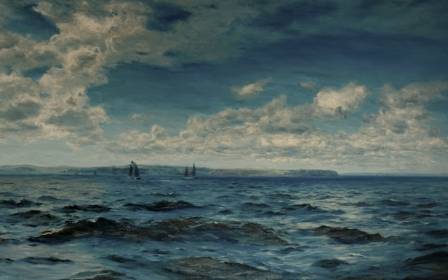
Marine art, frequently celebrated via seascapes, has captivated the creative minds of countless artists over the centuries. The coastline, with its ever-changing temperaments and stunning panoramas, ranks among the most potent sources of inspiration in the natural world. Artists are drawn to the ocean’s capacity to embody both serene waters and fierce, untamed energy—traits that mirror life’s inherent duality. From the soft ripple of waves along a quiet shoreline to the dramatic surge of a tempestuous sea, the ocean provides an inexhaustible well of creative stimulation. Caspar David Friedrich’s “The Monk by the Sea” presents a stark portrayal of sea and sky, underscoring humanity’s insignificance in the face of nature’s grandeur.
The allure of the coast lies not only in its scenery but also in the life it sustains. Seabirds glide above the surf, marine mammals break the water’s surface, and the interplay of light and color transforms the sea from the gentle radiance of dawn to the blazing hues of dusk. For many artists, the ocean serves as a sanctuary—a space where the mind finds tranquility and the spirit is rejuvenated. This profound bond with the world’s vast waters is evident in countless paintings, where the shore becomes a backdrop for exploring themes of hope, introspection, and nature’s enduring might.
Throughout the history of art, from Leonardo da Vinci’s innovative viewpoints to Claude Monet’s luminous impressionistic works, the sea has remained a constant fount of creativity. Seascape paintings invite audiences to experience the world’s beauty, reminding us of the deep connection between art, the coastline, and the natural realm.
Leonardo da Vinci’s Aerial View of the Coastline
Leonardo da Vinci’s “Bird’s Eye View of the Sea Coast” stands as a testament to his groundbreaking approach to perspective and his profound understanding of coastal geography. Crafted around 1515, this ink-on-paper masterpiece, measuring roughly 27.2 by 40 centimeters, merges elements of cartography, relief mapping, and imaginative vision. The work showcases Leonardo’s skill in depicting the interaction between land and sea with remarkable accuracy, using texture and shading contrasts to create a sense of depth and dimension.
The aerial perspective reveals the ocean merging with the land in curving bays, resembling a tailored blue carpet. Leonardo’s use of color brings out the features of the coastal landscape, blending realism with artistic imagination. This piece reflects his technical brilliance and innovative outlook, establishing it as a cornerstone in the history of seascape art, with every detail meticulously considered.
Katsushika Hokusai’s The Great Wave off Kanagawa
Katsushika Hokusai’s “The Great Wave off Kanagawa” is one of the most iconic marine artworks in art history. This woodblock print, created in 1831, has become a symbol of Japanese art, resonating deeply in both Eastern and Western artistic communities. The composition dramatically contrasts the enormous wave with small boats and distant mountains, evoking feelings of awe and human vulnerability. Hokusai’s “The Great Wave off Kanagawa” exerted a significant influence on Western art and is part of his series “Thirty-Six Views of Mount Fuji.”
Hokusai’s double-printing method and color technique—combining Prussian blue with traditional indigo—generate a striking, mesmerizing visual dynamism. This masterpiece captures the ocean’s power and beauty, igniting viewers’ imaginations and securing its place as an eternal work of art.
Capturing Turmoil: Rembrandt’s The Storm on the Sea of Galilee
Rembrandt’s “The Storm on the Sea of Galilee,” painted in 1633, is his only known seascape. This dramatic artwork depicts Jesus calming a storm, aligning with biblical narratives from the Gospels of Mark, Luke, and Matthew. Rembrandt’s distinctive approach includes a self-portrait among the disciples, forging a personal connection to the story.
The painting is defined by dramatic contrasts between light and shadow—a technique known as tenebrism—that amplifies the scene’s emotional depth. Measuring approximately 160 cm by 128 cm, this large-scale work was stolen in 1990 during the biggest art heist in U.S. history, and its location remains a mystery. Nevertheless, its impact and significance in seascape art endure.
Winslow Homer’s Untamed Seas
Winslow Homer is celebrated for his powerful depictions of the ocean’s wild, unpredictable nature. His seascapes often highlight fishermen’s struggle against the elements, portraying their dangerous livelihoods with vivid realism. In “The Fog Warning,” Homer illustrates a lone fisherman confronting advancing fog as he attempts to return home after a successful catch, capturing the perilous conditions at sea. The painting emphasizes the fisherman’s arduous journey, marked by both emotional and physical hardships as he navigates nature’s obstacles and makes critical decisions amid danger.
Another notable work, “The Gulf Stream,” features a man aboard a ship amid turbulent waters and sharks, representing the inherent risks fishermen face. Homer’s pieces convey the ocean’s raw power and mystery, making them some of the most compelling works in coastal art—particularly in their depictions of marine life.
Monet’s Impressions of the Ocean
Claude Monet’s contributions to seascape painting are integral to the Impressionist movement, with a focus on light and atmosphere. His iconic work “Impression, Sunrise” first introduced the innovative techniques of Impressionism, centering on the fleeting qualities of light and the portrayal of water.
Monet’s seascapes are celebrated for capturing the ocean’s ever-shifting moods and the remarkable range of tones, colors, and emotions in his depictions, rendering them timeless works of art. “Impression, Sunrise” played a pivotal role in naming the Impressionist movement and depicts the port of Le Havre at dawn.
Another notable seascape, “La Pointe de la Hève at Low Tide,” reflects a transitional phase in Monet’s style, focusing on the interplay of light and water. These works showcase Monet’s mastery in capturing the ocean’s serene beauty and dynamic essence, solidifying his status as a great seascape artist.
Ivan Aivazovsky’s Mastery of Light and Color
Ivan Aivazovsky is renowned for his extraordinary ability to capture the interplay of light and color in his seascape paintings. His masterpiece “The Ninth Wave” symbolizes the struggle between humanity and nature, illustrating the sea’s dramatic power through vivid colors and intense light contrasts. Aivazovsky frequently observed natural phenomena closely, sketching minimal outlines before creating detailed studio paintings. He produced over 6,000 works, with “The Ninth Wave” standing as his most famous.
Aivazovsky’s artistic style emphasizes emotional resonance in his seascapes, creating depth and drama that captivate viewers. His works are celebrated for their luminous quality, achieved by layering translucent paint to enhance the depiction of light and shadow. This skill makes Aivazovsky’s seascapes some of the most visually stunning and emotionally impactful in art history.
Coastal Charm in Dufy’s Baie des Anges, Nice
Raoul Dufy’s “Baie des Anges, Nice,” painted in 1927, is a vibrant portrayal of the Mediterranean coast. Nice—a lively coastal city—provides a unique urban backdrop that deeply influences Dufy’s work. The city’s energetic atmosphere and its relationship with the sea are reflected in his depiction, blending urban vitality with the Riviera’s natural beauty. Associated with the Fauvism movement, Dufy’s work emphasizes bold colors and expressive brushwork, creating a sense of space that captures the Riviera’s lively ambiance. His use of color and perspective highlights the Mediterranean’s beauty and warmth, making his seascapes visually engaging.
Dufy’s works often depict the deep, intense blue of the Mediterranean Sea, enhancing the visual experience with an unexpectedly warm shade of blue. The distinct shape of La Jetée-Promenade in his work accentuates the sea and sky’s warm blues, creating a scene that is both lively and serene, brimming with vibrant color. Dufy’s seascapes celebrate coastal beauty, encapsulating the essence of the seaside with his unique style.
Seascape Painting Techniques
Capturing the ocean’s essence in seascape painting requires a unique blend of observation, imagination, and technical skill. Many artists begin by studying wave movement, the shifting patterns of light on water, and the subtle color changes that occur throughout the day. Color usage is crucial—shades of Prussian blue, turquoise, and deep indigo are often layered to evoke the sea’s depth and mystery, while lighter tones reflect sunlight’s sparkle on calm waters. Artists find endless inspiration in the ocean’s changing colors, sounds, and moods.
Texture plays a vital role in bringing seascapes to life. Artists may use thick, expressive brushstrokes to depict crashing waves or smooth, blended techniques to create the illusion of glassy, tranquil surfaces. The balance between sky and sea is carefully crafted, with clouds, sun, and horizon lines providing a sense of scale and atmosphere. Reflections on the water’s surface add depth and realism, while the foreground may feature rocks, sand, or boats to ground the scene.
Composition is another key element—artists often use the coastline’s curve, the placement of ships, or a wave’s sweep to guide the viewer’s eye through the painting. Attention to detail, such as the glint of light on wet sand or the delicate foam of a breaking wave, enhances immersion. Whether painting en plein air on the beach or from memory in a studio, artists strive to capture not only the ocean’s appearance but also its essence—its energy, calm, and timeless beauty.
Through these techniques, seascapes become more than mere images; they are windows into the world’s oceans, inviting us to experience the coast’s wonder and majesty from the comfort of our homes.
Contemporary Seascape Artists from Cornwall
Cornwall is home to some of Britain’s most acclaimed contemporary seascape artists, including John Dyer, Joanne Short, and Ted Dyer. These artists capture Cornwall’s spectacular coastline, each bringing a unique perspective and style. Their seascapes often feature elements such as sailboats, lighthouses, and Cornwall’s stunning landscapes, making significant contributions to contemporary coastal art.
John Dyer’s Vibrant Coastal Scenes
John Dyer is celebrated as Cornwall’s most prominent contemporary artist, renowned for his vibrant depictions of the region’s landscapes and his commitment to environmental themes. As an official Artist for the Earth with EarthDay.org and artist-in-residence at the Eden Project, Dyer’s work often reflects his dedication to celebrating nature and addressing ecological issues. His colorful, dynamic seascapes capture the coast’s essence, breathing life into sea and shore scenes with his distinctive style.
Dyer’s work is exhibited at the John Dyer Gallery, which features a collection dedicated to his art—including prints of Cornwall and seascapes. His paintings are visually stunning and serve as a reminder of the importance of preserving our natural world, merging aesthetics with advocacy.
Joanne Short’s Exquisite Colorist Oil Paintings
Joanne Short is one of Cornwall’s most renowned contemporary artists, recognized for her exquisite colorist oil paintings that capture Cornwall’s beauty. An elected member of the Newlyn Society of Artists, Short’s work is celebrated for its vibrant colors and light, reflecting her deep connection to the coastal environment. Her paintings often depict Cornwall’s stunning landscapes and seascapes, bringing the region’s natural beauty to life with her unique style.
In addition to oil paintings, Short has expanded her artistic output to include ceramics and limited-edition prints, extending her influence beyond traditional painting. The John Dyer Gallery proudly represents Joanne Short’s work, showcasing her contributions to contemporary Cornish art.
Ted Dyer’s Timeless Masterworks
Ted Dyer, born in 1940, is recognized as one of Cornwall’s most accomplished and collected artists. With a painting career spanning over 60 years, Dyer is known for his impressionistic style and his ability to evoke nostalgia in his landscapes. His work is celebrated for its exceptional quality, depth, and mastery of paint, making each piece a modern masterpiece and a lasting heirloom for future generations.
Dyer’s paintings are prominently featured at the John Dyer Gallery, which claims exclusive representation of his work. His impressionist landscapes capture Cornwall’s coastal beauty, establishing him as one of the region’s most widely collected artists. Dyer’s remarkable, timeless masterworks continue to inspire and captivate art lovers, solidifying his legacy in seascape painting.