Plaza story
The Egyptian Pyramid
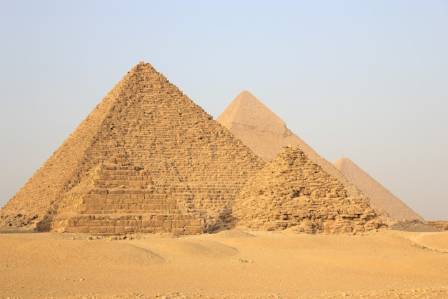
The pyramids of Egypt have fascinated explorers, rulers, scholars, and travelers for thousands of years. Even today, they continue to attract tourists, archaeologists, and researchers who study their design, measurements, construction methods, and historical significance.
Theodore Carlisle
City note
Sunny tip
The full plaza write-up continues below on the positive pulse board.
Board
NYC Good News
The pyramids of Egypt have fascinated explorers, rulers, scholars, and travelers for thousands of years. Even today, they continue to attract tourists, archaeologists, and researchers who study their design, measurements, construction methods, and historical significance.
These monumental structures remain among the most recognizable achievements of ancient Egypt, reflecting the civilization’s advanced engineering skills, religious beliefs, and dedication to honoring their rulers.
The Beginning of Pyramid Construction
Before true pyramids were created, ancient Egyptian royal tombs were built in the form of flat, rectangular structures known as mastabas. Around 2780 BCE, the architect Imhotep designed a revolutionary monument for King Djoser by stacking six progressively smaller mastabas on top of one another.
The result was the first pyramid in Egyptian history, the Step Pyramid of Djoser, located at Saqqara on the western side of the Nile River near Memphis. Like later pyramids, it contained a complex network of chambers and corridors, including the burial chamber intended for the king.
The Development of Smooth-Sided Pyramids
The evolution from stepped pyramids to the smooth-sided pyramid design occurred during the reign of King Snefru, founder of Egypt’s Fourth Dynasty (2680–2560 BCE).
At Meidum, Snefru’s builders transformed an earlier step pyramid by filling the outer layers with stone and covering the structure with limestone, creating a smoother appearance.
Another pyramid project was started at Dahshur with the goal of creating straight, sloping sides. However, during construction, the angle was changed halfway up, reducing the incline from more than 51 degrees to about 43 degrees. This unusual shape became known as the Bent Pyramid, and the adjustment was likely made to improve the stability of the structure.
A second pyramid at Dahshur was later built with sides rising at an angle slightly greater than 43 degrees. Although it achieved the true pyramid form, its lower proportions gave it a shorter and wider appearance.
The Great Pyramid of Giza
The most famous and largest Egyptian pyramid was built at Giza for King Khufu, also known as Cheops, the Greek version of his name. Khufu was the son of Snefru and ruled during the Fourth Dynasty.
The Great Pyramid originally covered more than 13 acres, with sides extending over 755 feet and rising at an angle of 51 degrees and 52 minutes. Its original height was approximately 481 feet, though erosion and the loss of outer stones have reduced it to about 450 feet today.
Researchers estimate that the stone blocks used in its construction weighed more than two tons on average, with some of the largest stones reaching weights of around 15 tons.
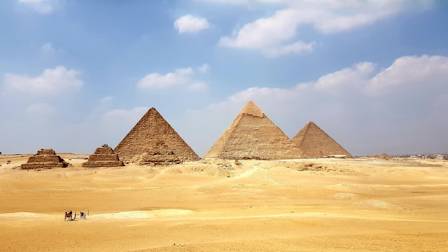
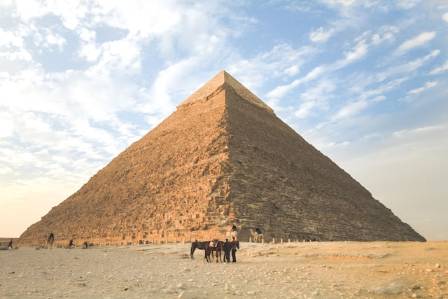
Two additional major pyramids were later constructed at Giza: one for Khufu’s son, King Khafre, and another for Khafre’s successor, King Menkaure. The Giza complex also includes the Great Sphinx, a massive sculpture featuring the body of a lion and the head of a human, believed to have been created during Khafre’s reign.
The Pyramid Complex and Religious Purpose
Egyptian pyramids were not isolated monuments but parts of much larger funerary complexes. These areas included temples, chapels, additional burial sites, and enormous protective walls.
Archaeologists have also discovered remains of ceremonial boats, with the best-preserved examples found at Giza. These vessels were likely connected to the religious journey of the deceased king.
The walls of pyramids built during the Fifth and Sixth Dynasties contain inscriptions known as the Pyramid Texts. These writings provide valuable information about ancient Egyptian beliefs, rituals, and ideas about the afterlife.
Because many ancient records have been lost, researchers still debate the exact functions of certain buildings within pyramid complexes and the precise details of royal burial ceremonies. It is believed that a king’s body was transported by boat along the Nile to the pyramid site, where it may have been prepared and mummified in the Valley Temple before being placed inside the pyramid.
How the Pyramids Were Built
The construction methods used to create the pyramids have long been the subject of research and discussion. Ancient Egyptians possessed copper tools, including chisels, drills, and saws, which may have been used to shape softer stones such as limestone.
Harder materials, especially granite used in burial chambers and exterior details, presented greater challenges. Workers may have relied on abrasive materials like sand combined with tools to cut and polish these stones.
Astronomical knowledge was essential for aligning pyramids accurately with the four cardinal directions. Builders likely used water-filled trenches to create level foundations before construction began.
Ancient artwork shows enormous stone statues being transported on wooden sledges across surfaces made smoother with liquid. Similarly, pyramid stones were probably moved on sledges and pulled up large ramps into position. Once the main structure was completed, the outer limestone covering was finished from the top downward, and construction ramps were removed.
Materials, Workers, and Construction Effort
Much of the stone used for the Giza pyramids came from quarries located directly on the Giza Plateau. Additional limestone for outer coverings was transported from Tura across the Nile, while granite used in certain chambers came from Aswan.
Some stone blocks contain markings left by quarry workers, including names of labor groups such as “craftsmen gangs.” Construction was likely carried out by skilled builders, including year-round workers, with seasonal labor forces joining during periods when agricultural work was limited.
The Greek historian Herodotus wrote in the fifth century BCE that Egyptian guides told him approximately 100,000 workers spent three months each year for twenty years constructing the Great Pyramid. Modern researchers generally believe the actual workforce was considerably smaller.
The Decline of Pyramid Construction
Pyramid construction reached its greatest importance during Egypt’s Fourth, Fifth, and Sixth Dynasties. Smaller pyramids continued to be built for more than a thousand years afterward, and many additional examples have been discovered, while others may still remain hidden beneath desert sands.
Over time, Egyptian rulers realized that pyramids could not fully protect royal mummies from determined tomb robbers. Later pharaohs chose hidden rock-cut tombs, such as those in the Valley of the Kings, instead of large visible pyramid structures.
Although the pyramids ultimately failed to preserve the physical remains of many kings, they succeeded in preserving their names, achievements, and stories. These extraordinary monuments continue to represent the power, creativity, and technological achievements of ancient Egypt.
More from the plaza
BLOCK · en

24 Best Surf Towns in the World: A Regional Guide
Whether you’re chasing perfect wave conditions or simply looking for a cool town with a surf-vibe, this guide highlights what the author considers some of the very best surf towns around the globe—organized by region and suited to surfers of various levels.
BLOCK · en

The Enchanting Cinque Terre: Fiat-Free Italy
I wake before most visitors in one of my favorite villages along the Italian Riviera. In Vernazza, the early sunlight reaches the top of the village bell tower and slowly brings the peaceful streets to life. The morning air is cool, damp and wonderfully fresh as I walk downhill and pass beneath the railway tracks.
BLOCK · en

Floating Cream on Coffee
Creating the perfect cup of coffee is a journey that many people enjoy refining over time. For those who like adding cream, getting that smooth, elegant layer floating on top can transform an ordinary drink into something visually stunning and indulgent. Achieving this effect isn’t just about pouring—it involves understanding a bit of science along with proper technique. Here’s a refreshed guide to help you master it.
BLOCK · en

Marine Life Spotlight: The Versatile Green Heron
The green heron (Butorides virescens) is a compact yet sturdy wading bird frequently spotted throughout North and Central America. While its distinctive coloration can be subtle from a distance, a closer look in the right light reveals a stunning palette of deep red and gray plumage, topped with an iridescent green crown and back.
BLOCK · en

The Timeless Allure of Marilyn Monroe’s Iconic Nude Photographs
In an era dominated by digital enhancement, Photoshop, and curated online personas, the concept of "authentic beauty" has become increasingly elusive. We are bombarded with edited images that blur the line between reality and fantasy, making it hard to recall a time when photography captured unfiltered, raw humanity. Yet, more than six decades after her passing, Marilyn Monroe remains a beacon of that bygone authenticity—her name evoking awe not just as a Hollywood starlet or "sex symbol," but as a figure who redefined beauty, courage, and self-expression. Among the countless celebrities who have followed, few have matched the enduring impact of her legacy, and her iconic nude photographs stand as testaments to a time when vulnerability and boldness coexisted to create art that transcends generations. These images are not merely snapshots of a woman; they are cultural touchstones that challenge societal norms, celebrate feminine power, and remind us of the enduring appeal of unapologetic truth.
BLOCK · en

The Most Unique Giants of the Sea: The Humpback Whale
Humpback whales are among the ocean’s most celebrated marvels, renowned for size, acrobatics, and intricate vocalizations. This piece revisits the story of humpbacks in Quebec’s Saguenay–St. Lawrence estuary, explores their remarkable traits, and explains how these marine giants feed, sing, and communicate. It also touches on conservation history and what makes humpbacks so distinctive within the whale world.