Plaza story
Manta rays possess one of the highest brain-to-body mass ratios among fish.
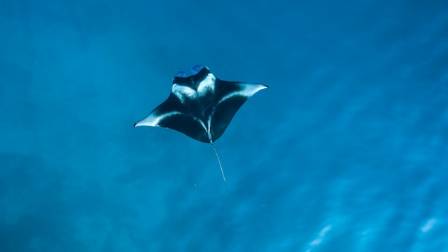
The giant manta ray (Mobula birostris) is the largest ray species on Earth.
Olivia Anderson
City note
Sunny tip
The full plaza write-up continues below on the positive pulse board.
Board
NYC Good News
Giant Manta Ray (Mobula birostris)
The giant manta ray (Mobula birostris) is the largest ray species on Earth. Its enormous wing-like body can reach an average width of around 22 feet, while exceptional individuals have been recorded with spans approaching 30 feet.
This species is easily recognized by its huge triangular pectoral fins that curve backward like wings. On both sides of its mouth are specialized cephalic fins, which can unfold and adjust their position to guide plankton-filled water into the mouth.
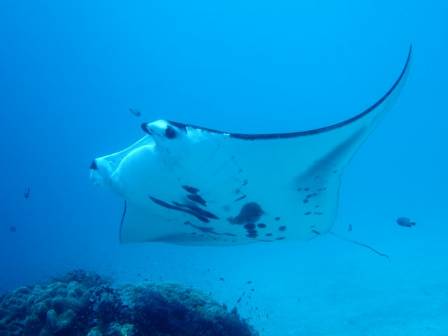
Giant manta rays are usually dark-colored on their upper surface and pale underneath. However, many individuals display unique patterns, including lighter markings on the back or darker spots on the underside. These natural patterns are different for every manta ray and can be used to identify individual animals.
They move through the ocean by gracefully flapping their large fins, often swimming in groups. These rays are also known to leap completely out of the water, a behavior that may be related to communication, courtship, or play.
Classification
Order: Myliobatiformes
Family: Mobulidae
Genus: Mobula
Species: birostris
Common Names
The giant manta ray has many common names around the world.
English names include:
- Manta ray
- Atlantic manta
- Australian devilray
- Blanketfish
- Devil ray
- Devilfish
- Eagle ray
- Giant devil ray
- Giant manta
- Giant Atlantic manta
- Great devilfish
- Pacific manta
- Sea devil
- Skeete
- Prince Alfred’s ray
Other languages also have their own names for this species, including:
- Diable de mer (French)
- Duivelsrog (Dutch)
- Jamanta (Portuguese)
- Manta (Italian)
- Manta Atlantica (Spanish)
- Oni-itomaki-ei (Japanese)
- Teufelsrochen (German)
- Urjamanta (Portuguese)
Importance to Humans
Historically, Mobula birostris has been captured in tropical regions of the Americas. In the past, commercial hunting occurred in Australian and Californian waters, mainly for obtaining liver oil and using the skin as an abrasive material.
Today, targeted hunting of manta rays is uncommon. However, manta meat is still considered a delicacy in some areas, including the Philippines.
Manta rays have become extremely valuable to the diving tourism industry because they are often encountered in predictable locations and may approach divers closely.
However, in places where people frequently touch or interact with manta rays, the animals may suffer damage. Removing their protective mucus coating can cause skin problems and increase the risk of infection.
Danger to Humans
Giant manta rays pose almost no threat to humans. They are considered harmless and are not aggressive toward people.
Conservation Status
The conservation status of the giant manta ray is evaluated by the International Union for Conservation of Nature (IUCN).
The IUCN is an international organization made up of governments, agencies, and conservation groups that evaluates the extinction risk and conservation needs of species worldwide.
Geographic Distribution
The giant manta ray lives in tropical, subtropical, and temperate oceans around the world.
Its range generally extends between approximately 35° north and 35° south latitude.
In the western Atlantic Ocean, it can be found from:
- South Carolina in the United States
- Southern Brazil
- Bermuda
Occasional sightings have also occurred as far north as New Jersey and San Diego.
Other regions where this species occurs include:
- Eastern Africa
- Gulf of Aden
- Red Sea
- Arabian Sea
- Bay of Bengal
- Indo-Pacific waters
Habitat
The habitat of Mobula birostris ranges from coastal areas to open ocean environments.
These rays are commonly found:
- Along continental shelves
- Near coral reefs
- Around offshore islands
- In surface and mid-water areas of lagoons and reefs
They swim by moving their large pectoral fins in a wing-like motion and may occasionally travel into cooler temperate waters.
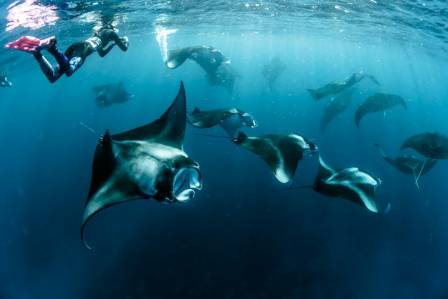
Giant manta rays are sometimes seen gathering in loose groups and spend much of their time near the ocean surface.
They are famous for breaching behavior, where they jump completely above the water before crashing back down.
Scientists have observed several types of jumps:
- Forward leaps landing head first
- Forward leaps landing tail first
- Somersault-style jumps
Groups of manta rays may perform these behaviors one after another.
Although the exact reason remains uncertain, researchers believe breaching may help attract mates, communicate with other rays, or simply represent playful behavior.
Biology
Distinctive Features
Adult giant manta rays are easily identified by their enormous triangular pectoral fins and their unique cephalic fins.
The cephalic fins are extensions of the front edges of the pectoral fins and are located on both sides of the head. Each fin is approximately twice as long as its width at the base.
When swimming, these fins are often rolled into spiral shapes. During feeding, they unfold and help direct water into the mouth.
This species has:
- Smooth skin
- A broad rectangular mouth located at the front of the head
- A tail without a venomous spine
Unlike many related mobulid rays, the manta ray’s mouth is positioned at the very front of the head rather than underneath.
The eyes and spiracles are located on the sides of the head, while the gill openings are located on the underside.
The body disc is about 2.2 times wider than its length when the cephalic fins are excluded.
The tail is slightly flattened and is shorter than the width of the body disc.
The head has a slightly curved shape between the cephalic fins, creating a shallow triangular area at the front.
A dorsal fin is located just before the pectoral fin axis, with a height approximately 83% of its base length.
Coloration
Every giant manta ray has a unique pattern of colors on both the upper and lower surfaces of its body.
Typical coloration includes:
- Dark brown
- Gray-blue
- Black upper surfaces
- Pale edges
- White underside
Some individuals have additional pale markings on their backs or dark patches underneath.
Because these patterns differ between individuals, scientists use them to recognize and track specific manta rays.
Teeth
Unlike many predatory rays, giant manta rays have very small teeth only on the lower jaw.
The center of the lower jaw contains approximately 18 rows of teeth, while the number decreases toward the corners of the mouth, where only about 12–14 rows remain.
Denticles
Small cone-shaped and ridge-like structures called tubercles occur across the body surface.
These structures are scattered over:
- The body disc
- Pelvic region
- Tail area
They appear on both the upper and lower surfaces, with the underside tubercles showing radial patterns.
Size, Age, and Growth
The giant manta ray can reach an exceptional body width of approximately 29.5 feet (9 meters).
The average width is around:
22 feet (6.7 meters)
Large individuals may weigh as much as:
3,000 pounds (1,350 kilograms)
Their estimated lifespan is about:
20 years
More from the plaza
BLOCK · en

10 Interesting Facts About Rabbits
The oldest known rabbit, named Flopsy, lived to be 18 years and 10 months old. Originally a wild rabbit, Flopsy entered the Guinness Book of Records under the care of its owner.
BLOCK · en
5 Enchanting Creatures In Asia
Indian Rhinoceros (India, Asia) The Indian Rhinoceros claims the top spot as the most endearing animal, defying stereotypes with its natural charm. Its large, expressive eyes and disproportionate body create a "gentle giant" effect, making it a beloved member of India's wildlife.
BLOCK · en

Delicious caramel pudding
Whenever I think of caramel pudding, memories of my grandmother’s kitchen come rushing back—the soft clinking of her mixing bowls, the aroma of sugar turning golden and filling the cozy farmhouse. This dessert was always a labor of love, a simple yet heartwarming treat in a ramekin. Today, I’m thrilled to share her treasured recipe with you.
BLOCK · en
The most beautiful sea for your yachting holiday
Sailing can be an incredible experience almost anywhere, but certain destinations have a little extra magic, especially when you are planning your first yacht holiday. Sunshine, weather conditions, surrounding landscapes and the overall atmosphere can all have a major influence on how enjoyable your cruise becomes. To make choosing easier, here is an overview of some of the finest seas for sailing. If you are still undecided about where to head, any of these destinations can make an excellent choice.
BLOCK · en

Exploring the Enigmatic Depths: Drach Caves in Mallorca
The Drach Caves, a remarkable system of four expansive caverns in Mallorca, beckon adventurers to unearth the mysteries concealed beneath the earth's surface. These subterranean wonders are not merely a sight to behold; they are a journey through time, believed to have emerged during the Miocene Epoch, spanning a staggering 23 to 5 million years ago.
BLOCK · en

Coastal Towns and Villages
Stretching along the shoreline, from wide sandy beaches to secluded rocky coves, Maine’s coast is filled with beautiful villages and lively seaside communities. Each destination has its own character, offering visitors scenic views, local culture, historic charm, and unforgettable coastal experiences.