Plaza story
Fantastical robots inspired by animals and insects
German engineering company Festo has developed a series of unusual robots that take inspiration directly from animals and insects. One of its most striking creations is a spider-like robot that can appear intimidating even when motionless.
Amelia Brooks
City note
Sunny tip
The full plaza write-up continues below on the positive pulse board.
Board
NYC Good News
German engineering company Festo has developed a series of unusual robots that take inspiration directly from animals and insects. One of its most striking creations is a spider-like robot that can appear intimidating even when motionless.
However, when it activates its special ability—curling into a compact shape and rolling forward—it becomes even more striking, almost as if it is chasing its surroundings.
Despite its dramatic appearance, this robot is not designed to cause harm. It is modeled after a real species of spider found in the Moroccan desert that escapes predators by flipping and rolling across the sand using its legs.
Robotics Inspired by Biology
This type of engineering belongs to a field known as bionics, where machines are developed based on biological systems. According to Elias Knubben, who leads corporate bionic projects at Festo, the goal is not simply to copy nature but to understand it.
He explains that engineers study living organisms to discover efficient natural principles that can be applied to solve technical problems. Instead of imitation, the focus is learning from evolutionary design.
The Flic-Flac Spider Inspiration
Deep in the dunes of the northern Sahara lives the Moroccan flic-flac spider. When threatened, it can dramatically increase its speed by flipping, rolling, and cartwheeling across the sand.
Unlike most animals, its movement style is completely unique, making it an exceptional subject for robotic inspiration. Interestingly, this creature was not initially discovered by a traditional biologist, but by Professor Ingo Rechenberg, a pioneer in bionics who has studied desert environments for decades.
Rechenberg’s fascination with the spider eventually led him to collaborate with Festo engineers to recreate its movement in robotic form.
BionicWheelBot: The Robo-Spider
From this collaboration came the creation of the BionicWheelBot. This robotic spider is significantly larger than its biological counterpart, measuring about 1.8 feet, while the real spider is less than an inch long.
To replicate its complex movement, engineers equipped it with around 15 small motors that coordinate its legs and rolling motion. Because of its shape and movement style, some observers compare it to fictional battle machines from science fiction films, though the designers emphasize that any resemblance is accidental.
Although still a research prototype rather than a commercial product, the robot demonstrates potential applications in areas where uneven terrain is a challenge. These include agriculture, underwater exploration, and even planetary exploration such as missions on Mars, where traditional rovers can struggle in soft sand.
Festo’s Flying Robot Innovations
Festo has also developed a range of aerial robots inspired by birds and other flying creatures. One of their most famous early creations was a robotic bird modeled after a seagull, designed to mimic natural wing flapping rather than using propellers.
Unlike conventional drones, flapping-wing robots are much more difficult to design because they do not rely on continuous lift from rotating blades. Instead, they generate lift through rhythmic motion, similar to real birds.
BionicFlyingFox: Bat-Inspired Flight
Another advanced project is the BionicFlyingFox, which takes inspiration from the flying fox bat. With a wingspan of about 7.4 feet, this robot is capable of controlled semi-autonomous flight once launched, while human operators assist mainly during takeoff and landing.
One of the biggest engineering challenges was designing wings that could fold efficiently while still being lightweight and flexible. To solve this, engineers developed a special elastic membrane using 3D-knitted fabric combined with airtight film layers.
The result is a large yet lightweight structure that can bend and stretch without breaking.
Other Bio-Inspired Robots
Festo’s collection of animal-inspired machines also includes:
A helium-filled robotic penguin designed for aerial stability
A lightweight dragonfly robot with four wings
eMotionButterflies, small robotic insects that demonstrate swarm behavior
These butterfly robots were among the company’s earliest experiments in group coordination, mimicking how real insects move collectively. Later designs improved upon this idea using ants as a model for even more advanced swarm intelligence.
Purpose Beyond Commercial Sale
Unlike typical consumer robots, none of these bionic machines are intended for sale. According to Knubben, Festo receives interest from industries such as toys, drones, and even military applications, but the company chooses not to commercialize them.
Instead, they are used as research platforms and demonstration models shown at exhibitions, conferences, and museums.
Festo’s main business remains industrial automation and pneumatic systems, while its robotic animals serve as experimental tools for innovation.
Concept Cars of Robotics
The development approach is similar to concept cars in the automotive industry. These vehicles are not always intended for production but serve as experimental designs to test new ideas and technologies.
Similarly, Festo’s bionic robots help engineers explore new mechanical principles that may eventually influence real-world industrial machines.
For example, studying how a robotic kangaroo stores and releases energy during jumping has helped engineers design more efficient motion systems for industrial automation, where machines frequently start and stop in repeated cycles.
Conclusion
Festo’s animal- and insect-inspired robots demonstrate how closely technology can connect with nature. By studying creatures such as spiders, bats, birds, and butterflies, engineers are able to create machines that move in surprisingly organic ways.
These robots are not just technological showcases—they are research tools that reveal how natural systems can inspire more efficient and innovative engineering solutions.
More from the plaza
BLOCK · en

9 Flowers That Bloom Year-Round
While many flowers follow a seasonal cycle, there are some that bloom continuously throughout the year. Once you discover which flowers have this impressive ability, you might want to fill your space with them. After all, it’s common to feel a bit down when vibrant, colorful flowers fade away (so make sure to plant some winter blooms to keep the cheer alive).
BLOCK · en

Idyllic U.S. Small Towns That Transform into Winter Wonderlands
As the season transitions to winter, the allure of travel beckons. The good news is you don't need a passport to savor the magic of the upcoming chilly months. Across the United States, you'll discover a tapestry of snow-capped mountains, serene farmlands, cozy inns, and a myriad of outdoor activities. These picturesque small towns promise a winter escape that's nothing short of enchanting.
BLOCK · en

Great Salt Lake
Great Salt Lake is the largest saltwater lake in the Western Hemisphere and ranks among the world’s largest saline lakes. Its ecosystem represents a remarkable connection between humans, nature, water resources, wildlife, and survival. The lake’s diverse habitats, including wetlands, islands, and shorelines, support a wide variety of life such as plants, brine shrimp, reptiles, amphibians, mammals, shorebirds, and waterfowl.
BLOCK · en

Coastal Guardians
These elegant palms sketch poetry against the shimmering coastal horizon. As the sun dips low and the sky flushes with coral and gold, coconut palms sway gently above the tideline—silent, windblown poets composing in silhouette. Their fronds arc in rhythm with the surf, drawing invisible verses across the sky.
BLOCK · en

The Eight Bear Species of the World
The North American Black Bear is the most widespread bear species on the continent, inhabiting areas from Florida in the south, across Canada, and as far north as Alaska. Although its name suggests a black coat, this species can appear in several color variations, including black, bluish-black, brown, and the rare white Kermode or Spirit Bear found mainly in northwestern British Columbia, Canada. Black and brown color phases are the most commonly seen.
BLOCK · en
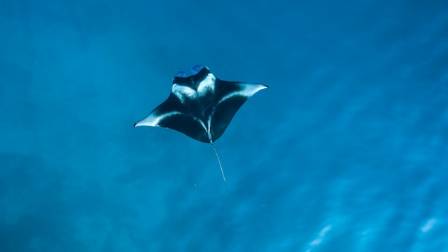
Manta rays possess one of the highest brain-to-body mass ratios among fish.
The giant manta ray (Mobula birostris) is the largest ray species on Earth.